Humans have been displaced before, hierarchically, geographically, and perhaps even metaphorically. The causes of displacement were primarily due to new scientific discoveries that led to major paradigm shifts. With AI, a new displacement may be looming. The answers to questions of whether AI can indeed replace humans, or whether it can become self-conscious, or a sentient being, depend on our worldview and what we think sets us apart as humans.
But whether these are a possibility is beside the point. AI has been causing a wave of existential disruption of varying magnitudes, from career and identity-related ones to an introspection about what differentiates us as humans, and what the future will look like in an AI-driven world. This is getting us to reexamine yet again what it means to be human. This time though the anxiety caused by such a potential displacement is different from the previous ones. And I want to explore why in what follows.
One major displacement took place during the scientific revolution. Built on long traditions that placed humans at the center of the universe, fostered by monotheistic religions, things took a turn with the Copernican revolution. All of a sudden, the earth was not the center of the universe. The sun was not really rotating around the earth, but the reverse was true.
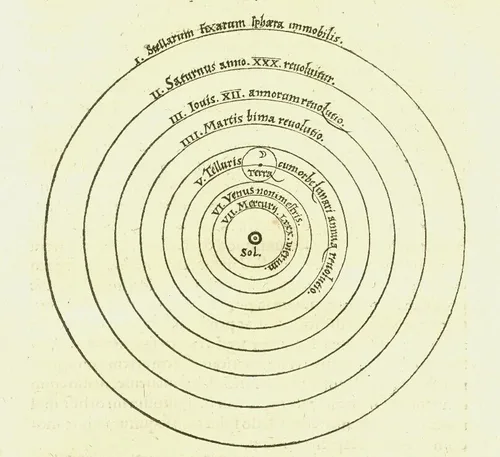 Nicolaus Copernicus, De revolutionibus orbium coelestium (1543). Public domain.
The great chain of being adopted by the Christian doctrine, and embraced by the cultural and artistic movements during the Renaissance, lost its meaning. What is the position of humans in this universe? We are no different than the plants, animals, or angels. We’re not that remarkable. At least not in the geographical sense we’re not. Suddenly humans found themselves displaced from the center.
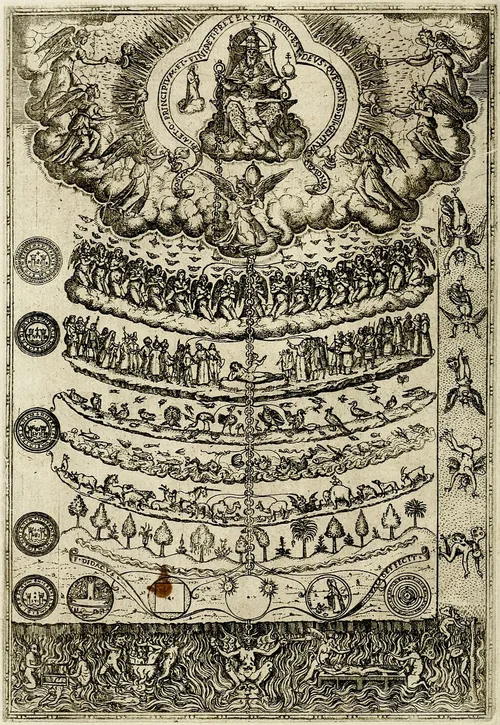 Diego de Valadés, Rhetorica Christiana (1579). Public domain.
The question posed is one concerned with the meaning of the affirmation. What does it mean for humans to be at the center of the universe? We are exceptional, different creatures, embodying both earthly as well as heavenly elements. We are rational animals who have instincts, desires, and emotions alongside reason. But we are also partly divine, with a spiritual element, a soul, that is more similar by nature to the angels. We get to choose what we want to become during this life. We either cultivate our animalistic side, and become more rooted in earth. Alternatively, we aim for knowledge of god, cultivating our spiritual side, liberating thereby our spirit, and getting closer to god along the way.
Such a worldview is foundational by nature. It is based on the beliefs and principles of those who adopted such a philosophy. The empirical observations before the invention of the telescopes and the rational, mathematical calculations of Copernicus, Galileo, and Newton confirmed the view that humans are indeed at the center of the universe. It did seem that the sun revolved around the earth. This account acted as a support or evidence for the underlying worldview.
When it was shaken by new scientific discoveries, the belief remained the same despite the disruption. What changed was how humans reacted to this news. Maybe we are qualitatively exceptional rather than quantitatively so. Do we really need to be at the center of the universe almost literally? The underlying assumption held: humans stand apart.
A few centuries later, a new paradigm emerged that caused yet another major displacement. Darwin, among others, would propose that humans are not nearly as exceptional as they thought. They are simply the product of years of evolution, mired by fierce competition, the survival of the fittest, gene mutations, and luck, on a journey from being a simple unicellular organism to the sophisticated creatures that we became.
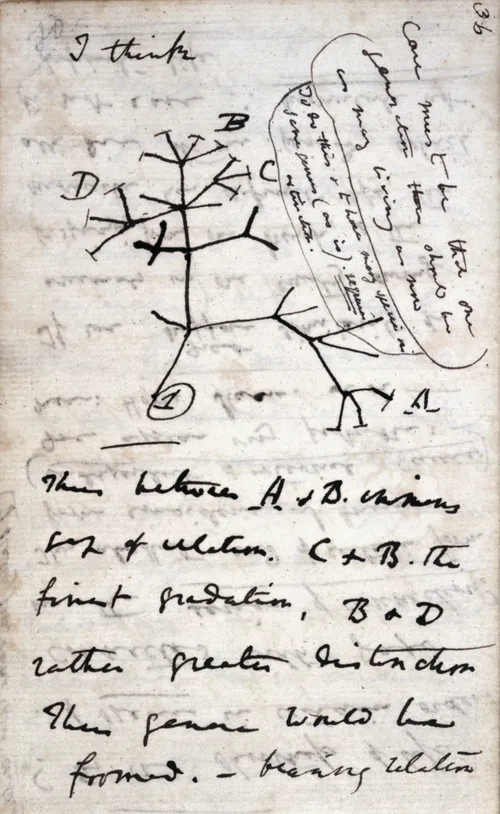 Charles Darwin, Notebook B: Transmutation of Species (1837). Public domain.
Now not only were humans not that special in the universe, but they were also the product of natural forces that evolved over time. Freud would later, influenced by the German idealists like Schelling, add insult to injury by highlighting how we are opaque to ourselves, with our conscious mind being the tip of the iceberg. Submerged is a mix of elements, emotions, and unrealized desires, that are either suppressed or of which we are just not aware, but which condition how we react to and interact with the world.
What is a human being then? How special are we? Yet another displacement was in order. However, the underlying assumption that we are special endured. That we may have been the result of billions of years of evolution does not change the fact that we stand apart from other creatures on earth. We developed a language, managed to build up a repertoire of knowledge shaped by our philosophical and technological advancements, and we created an unparalleled wealth of cultural and artistic output. No other species managed to do that. Surely we are different? Not only do we speak many languages, but we are also conscious of the world around us. We are in fact self-conscious of both of these things.
The two episodes may have shaken things up a bit for humans, but the core belief that we are special survived. The reason for this is that while these scientific discoveries altered our paradigms and worldviews, fundamentally, nothing really changed about the nature of humans. We may have experienced a physical, geographical, or hierarchical displacement, but we had no rivals when it came to the qualitative dimension of our existence. Something is indeed distinctive about humans.
These paradigmatic changes were triggered by new scientific discoveries that merely affected how we understood our story as humans. The explanations offered were of the external or objective kind, with foundations in biology, chemistry and physics. The human core, whatever that is, was not affected, not even with Freud’s psychoanalytical theory.
However, something else is happening with AI. It doesn’t really matter whether generative AI, or AI agents are or can become self-conscious. We still don’t understand what the nature of consciousness is, and all our attempts so far have been unsuccessful. What generative AI and large language models are doing, however, is a new kind of displacement. They are making us question our place in this universe. Only this time not from a hierarchical or geographical dimension, but from a more serious existential angle.
The belief that we are different, whether backed by a religious outlook on the world, a humanistic philosophy, or something else, has been somewhat based on a set of self-evident assumptions rather than scientific proofs. Humans have a distinctive being, and this is qualitatively distinct.
With AI this core belief is being shaken. AI may or may not be conscious, or achieve general artificial intelligence; that isn’t really the question. What matters is that somehow, generative AI has made us, or some of us, feel deeply challenged about what it means to be human. This time the creeping doubt is a psychological and existential one. Whether or not agents can be sentient does not change the fact that some of us are now asking ourselves what that means for us as a species.
When AI is capable of mimicking certain activities, producing texts, replacing other humans at work, and even expressing emotions, and when different voices begin to sound the alarm about the need to adopt a more responsible, ethical, and humanistic approach to AI, including the recent Papal encyclical, which also triggered a mix of supporters and opponents, we ought to consider what it is about AI that is triggering this deep-rooted anxiety. I think that it’s at least making us question our place in the universe. But this time it’s different, because the displacement is not triggered by a scientific discovery about how the world works. Rather, it’s instigated by something that we created ourselves, in our own image, and which is playing pretend at the very thing that we thought made us special, and differentiated us from the rest of the species.
“In the era of artificial intelligence, when human dignity is threatened by new forms of dehumanization, ours is the pressing duty to remain profoundly human. We must lovingly safeguard the grandeur of humanity bestowed upon us and revealed in its fullness in Christ, the splendor of which no machine can ever replace.”
— Pope Leo XIV, Magnifica Humanitas, §15 (2026)