This month we’re discussing Daniel Coyle’s The Culture Code in the Tech Leaders Salon. Below are some preliminary ideas and questions. I will be publishing a more detailed reflection after the discussion here.
The book challenges standard management assumptions (Laksh also does so in his book Mistakes of Mainstream Management). Coyle’s premise is that while individual skills matter, cultivating a good culture, be it at a big organization, a sports team, or a small business, requires focusing on the interpersonal and relational dimension. Having qualified and skilled people is good, yes, but what they do together is more important for building a better culture.
As such, culture is built on good, dynamic relationships that require, according to Coyle, the following 3 key skills:
- building a comfortable space for interaction, where people can speak freely and aren’t disincentivized or under constant threats of being admonished for sharing their ideas
- sharing vulnerability, which is important for fostering stronger bonds across vertical as well as horizontal relationships
- establishing a purpose for the group
While Coyle highlights the importance of these elements, and offers actionable strategies at the end of each part, the book offers a storytelling-based narrative rather than a formulaic how-to approach. When it comes to culture that works, then, there’s no one-size-fits-all approach. Instead, there are certain aspects that might be well worth looking into, picking and choosing whatever is more suitable for the context we find ourselves in.
“Successful culture can look and feel like magic, but the truth is that it’s not. Culture is a set of living relationships working toward a shared goal. It’s not something you are. It’s something you do.”
Key ideas
Building Safety
“Safety is not mere emotional weather but rather the foundation on which strong culture is built. The deeper questions are, Where does it come from? And how do you go about building it?”
Belonging cues: Signals that make us switch from ‘guard dog’ to ‘guide dog’. They require energy, individualization, and future orientation.
“Belonging cues are behaviors that create safe connections in groups. They include, among others, proximity, eye contact, energy, mimicry, turn taking, attention, body language, vocal pitch, consistency of emphasis, and whether everyone talks to everyone else in the group. Like any language, belonging cues can’t be reduced to an isolated moment but rather consist of a steady pulse of interactions within a social relationship.”
Psychological safety: Letting people know that they belong, that they won’t be let off the hook just because. Once the sense of danger subsides, people start behaving differently under a psychological safety net.
Feedback: Sandwiched feedback doesn’t work because people are not stupid. There seem to be two types of feedback: one where you’re telling people you expect the very best from them, leading them to maybe work harder and improve their performance (a simple example would be a football player who needs to exercise more to improve their performance on the pitch). The second type of feedback is where you highlight what needs improvement and give specific guidance to help the person get there.
Sharing Vulnerability
“Normally, we think about trust and vulnerability the way we think about standing on solid ground and leaping into the unknown: first we build trust, then we leap. But science is showing us that we’ve got it backward. Vulnerability doesn’t come after trust—it precedes it. Leaping into the unknown, when done alongside others, causes the solid ground of trust to materialize beneath our feet.”
The leader as a midwife (Socrates called himself a midwife of ideas): When things aren’t as clear, hopefully not as critical as a plane in free fall like the example in the book, a good leader opens up to the group and asks them what ideas they have rather than issuing commands.
Candor over honesty: The goal is candor (targeted, less personal) rather than brutal honesty.
“The most important part of creating vulnerability often resides not in what you say but in what you do not say. This means having the willpower to forgo easy opportunities to offer solutions and make suggestions. Skilled listeners do not interrupt with phrases like ‘Hey, here’s an idea’ or ‘Let me tell you what worked for me in a similar situation’ because they understand that it’s not about them.”
Establishing Purpose
“Purpose isn’t about tapping into some mystical internal drive but rather about creating simple beacons that focus attention and engagement on the shared goal. Successful cultures do this by relentlessly seeking ways to tell and retell their story. To do this, they build what we’ll call high-purpose environments.”
High-purpose environments: Filled with clear signs and signals linking the present moment to a future goal: Here is where we are and here is where we want to go.
Identifying priorities: This is important to understand what the group’s priorities are, this way they can work collectively towards a shared goal, creating good engagement around them. These priorities would later come in handy to tacitly guide a group through a crisis.
One such example comes in chapter 13 (three hundred and eleven words.) Here Coyle uses the J&J Tylenol poisoning crisis. I want to dwell a bit more on this one because it has an underlying philosophical dimension. The company was famous for its Credo, a short one-page document of 311 words. The Credo, which is Latin for ‘I believe’ encapsulates the company’s philosophy, values, responsibility, and list of priorities. It was first written by one of the Johnson founding members Robert Wood Johnson in 1943.
“We believe our first responsibility is to the patients, doctors and nurses, to mothers and fathers and all others who use our products and services. In meeting their needs everything we do must be of high quality. We must constantly strive to provide value, reduce our costs and maintain reasonable prices. Customers’ orders must be serviced promptly and accurately. Our business partners must have an opportunity to make a fair profit.”
Without getting too much into the details, James Burke, who was president of J&J back then, called for a meeting in 1975 with the top executives of the firm to discuss the Credo and what it meant for them. The meeting turned into a philosophy seminar, Coyle explains, and by the end of it, they had not only dissected, examined, and discussed the document’s content, but they had also renewed their commitment to it. Everyone was onboard.
This document set forth the company’s core values and priorities, which, Coyle explains in more detail, helped them deal with the Tylenol poisoning crisis serenely. That is because they knew what their priorities were, and the decisions they had to make on the fly were grounded in a set of beliefs that made them take ownership, adopt a transparent attitude towards their customers and stakeholders, recalled all the Tylenol units from the market despite the losses, focusing more on public safety, and rebuild trust with their customers.
Proficiency vs. creativity: Leading for proficiency requires clear, if x then y, rules of thumb. Leading for creativity requires protecting the team’s autonomy to discover the path to an unknown destination.
“Building purpose in a creative group is not about generating a brilliant moment of breakthrough but rather about building systems that can churn through lots of ideas in order to help unearth the right choices.
This is why Catmull has learned to focus less on the ideas than on people—specifically, on providing teams with tools and support to locate paths, make hard choices, and navigate the arduous process together.”
Final thought
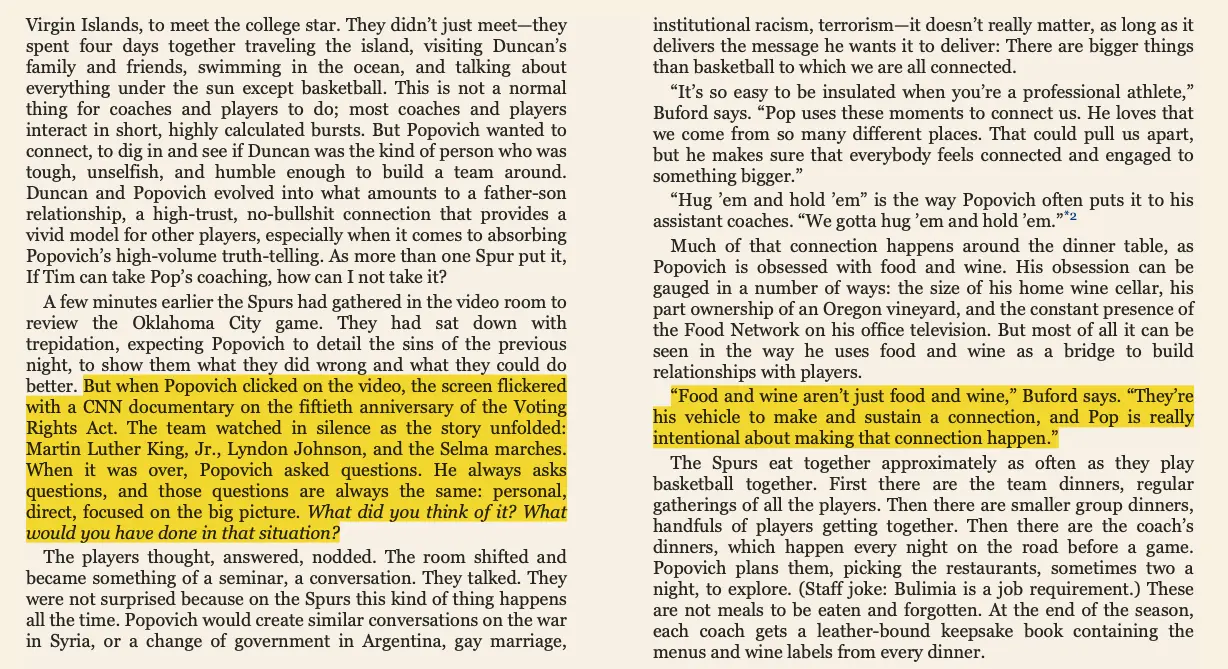
On that note, I’ll leave you with this. To play better basketball, read philosophy, and have conversations over food and drinks. Gregg Popovich knows where it’s at.
Questions for our discussion
- What are your thoughts about the spaghetti-marshmallow experiment?
- What matters more for you, if at all, individual skills or the quality of interactions within a group?
- Coyle suggests that vulnerability precedes and leads to trust. What do you think about this idea?
- How do we distinguish between a gadfly who challenges our assumptions and a jerk who actively destroys group safety?
- How can we ensure good communication across teams in the era of remote work and AI?